Room Guides
Living room lighting: a layered guide for Indian homes
Most living rooms in India are lit by a grid of cool-white downlights and nothing else. A few warmer sources at different heights will do more for the room than any amount of new furniture.
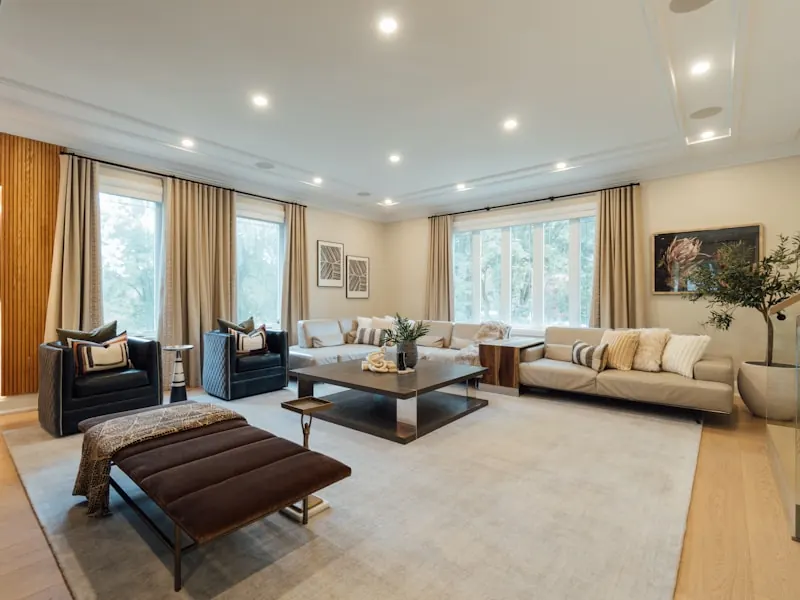
Lighting is the cheapest way to change how a room feels, and the most frequently neglected. In many new apartments we visit, the living room has a neat grid of six or eight recessed downlights at 6500K “cool daylight”, switched on together from one switch. The room is bright, but it is flat: no shadows, no warmth, harsh on faces and on the eyes after sunset. This guide shows how to plan living room lighting the way designers do — in layers, with numbers.
Think in three layers
Good lighting combines several sources at different heights, each doing a different job.
| Layer | Job | Typical sources |
|---|---|---|
| Ambient (general) | Lets you move around safely and see the room as a whole | Cove lighting, downlights, a central fitting, indirect wall washing |
| Task | Light where you do something specific — read, play board games, work on a laptop | Floor and table lamps, adjustable spots, a pendant over a table |
| Accent | Draws the eye to texture, art or architecture; creates depth | Wall washers, picture lights, lit niches, uplights on plants |
| Decorative | The fitting is the feature — it sets the mood more than it lights the room | Chandeliers, sculptural pendants, statement lamps |
A room lit only by ambient light feels like a waiting area. A room lit only by lamps is cosy but hard to clean or find things in. The aim is to be able to switch between them.
How much light? Lux and lumens, simply
Lumens measure how much light a fitting gives out. Lux measures how much light lands on a surface: one lux is one lumen spread over one square metre. Designers plan in lux, then work back to lumens and fittings. These are the levels in our design standards, in line with the Indian lighting code (IS 3646) and the National Building Code:
| Room | General light | Colour temperature | Task light |
|---|---|---|---|
| Living room | 150–300 lux | 2700–3000 K | Reading corner 300 lux |
| Dining | 150–200 lux | 2700–3000 K | Pendant over the table |
| Kitchen | 300–500 lux | 3000–4000 K | Worktop task light 500 lux |
| Bedroom | 100–150 lux | 2700 K | Bedside reading 300 lux |
| Children's room | 200–300 lux | 3000–4000 K | Study desk 500 lux |
| Study / home office | 300–500 lux | 4000 K | Desk 500 lux |
| Bathroom | 150–300 lux | 3000–4000 K | Mirror 300–500 lux |
| Pooja room | 150–200 lux | 2700 K | Accent on the idol / mandir |
| Corridor / stairs | 100–150 lux | 3000 K | Step lights at night |
A worked example
Take a 12 × 15 ft living room — 180 sq ft, or about 16.7 m². For a general level of 150 lux you need 150 × 16.7 ≈ 2,500 lumens reaching the floor. Fittings lose light to the ceiling, walls, lampshades and dust, so divide by about 0.6 to get the lumens your fittings should produce: roughly 4,200 lumens.
A good 9 W LED downlight gives about 800–900 lumens. 6 of them deliver around 5,100 lumens, or about 180 lux after losses — enough for general light. Now add a cove and two lamps, put the downlights on a dimmer, and you can run the room from a soft evening glow to the top of the 150–300 lux range. Our lighting calculator does this arithmetic for any room.
Colour temperature and CRI
Colour temperature, measured in kelvin (K), describes how warm or cool white light looks. It matters more than brightness for how a living room feels.
| Colour temperature | Looks like | Use it for |
|---|---|---|
| 2700K (warm white) | Incandescent-lamp warmth | Lamps, bedrooms, evening scenes |
| 3000K (warm white) | Warm but crisp | Living and dining rooms — our usual default |
| 4000K (neutral white) | Clean, alert | Kitchens, study desks, bathrooms |
| 5700–6500K (cool daylight) | Bluish, clinical | Utility areas, garages; avoid in living rooms |
Two rules make an enormous difference:
- Do not mix colour temperatures in one view. A 3000K cove next to 6500K downlights makes both look wrong.
- Choose CRI 90 or above. The colour rendering index measures how faithfully light shows colours. Cheap LEDs with CRI around 80 make wood look grey, skin look sallow and that expensive sofa fabric look dull.
Paint and light work together: a warm grey under 6500K turns cold blue. If you are choosing wall colours, test them under your actual bulbs — our paint colour guide explains how.
Fixtures, placement and indicative prices
| Fixture | Layer | Placement guide | Indicative price, 2026 |
|---|---|---|---|
| LED downlight / slim panel (12–18 W) | Ambient | 1,200–1,800 mm apart, 600–900 mm from walls | ₹350–1,200 each |
| COB spotlight | Accent | 300–600 mm from the wall it lights | ₹500–2,000 each |
| Cove LED strip | Ambient | Hidden in a cove, lighting the ceiling | ₹90–180 /rft |
| Profile (linear) lights | Ambient / accent | Recessed along a ceiling line | ₹350–700 /rft |
| Track light (per head) | Accent | On a ceiling track; heads aimed as needed | ₹1,200–4,500 |
| Pendant light | Decorative / task | Centred on furniture, not the room | ₹2,500–25,000 each |
| Chandelier | Decorative | Over a dining table or in a double-height space | ₹15,000–₹1.5 lakh |
| Floor lamp | Task | Behind and beside a reading chair | ₹4,000–30,000 |
| Table lamp | Task / ambient | On a console or bedside | ₹1,500–12,000 |
| Wall sconce | Accent / ambient | About 1,500–1,700 mm above floor | ₹1,500–12,000 each |
Heights and clearances
- Pendants over a coffee or dining table: bottom of the fitting about 700–800 mm above the table top.
- Chandeliers in walk-through areas: keep at least 2,100 mm clear above the floor.
- Reading lamps: the bottom of the shade near seated eye level, roughly 1,000–1,100 mm from the floor, placed slightly behind the shoulder of the reader.
- Downlights near walls: too close (under 300 mm) and they create harsh “scallops” on the wall; that is fine for a textured feature wall, not for a plain one.
Lighting the TV wall
The TV wall is where most living room lighting goes wrong. Avoid downlights directly in front of the screen — they reflect in it. Instead:
- Light the wall softly from a cove or a concealed strip behind the TV panel, so the screen is not a bright rectangle in a dark wall (which tires the eyes).
- Keep ambient light low and dimmable during viewing — a soft glow, well below the everyday level.
- Put accent lights for the TV unit’s shelves on a separate switch.
Switching, dimming and scenes
The best fittings in the world cannot help if they are all on one switch. Wire each layer as its own circuit, and plan at least these scenes:
| Scene | What is on | Roughly |
|---|---|---|
| Everyday evening | Cove at 70%, two lamps, downlights off | Around 150 lux |
| Guests | Cove, downlights at 60%, accents on | Up to 300 lux |
| Movie | Cove at 20%, TV backlight, everything else off | A low glow |
| Night path | One low wall light or a plinth strip | Just enough to walk |
Dimming that actually works
Not every LED dims smoothly. Ask for dimmable drivers matched to your dimmer type — a cheap combination will flicker, hum or jump from 30% to off. For larger homes, smart switches or a simple scene controller save a lot of button-pressing, but always keep a basic manual switch as a fallback.
Central-India specifics
- Power cuts: put at least one light per room on the inverter circuit. LEDs draw little power, so this costs almost nothing in inverter capacity.
- Heat: LED drivers hidden inside false ceilings need air around them. Do not bury them under insulation, especially on top floors, where ceiling voids get very hot in May.
- Monsoon insects: bright cool-white lights near open windows and balconies attract more insects. Warmer light at windows and balcony doors helps.
- Dust: open coves collect dust in the dry months. Narrow cove openings and a quick clean before Diwali keep them glowing evenly.
LED fittings use a fraction of the power of older tube lights and halogens; if you are curious about your bill, our electricity bill calculator estimates monthly costs by appliance.
A sample plan for a 12 × 15 ft living room
Here is how the layers come together in a typical apartment living room with a TV wall, a sofa facing it and a reading chair by the window. Each line is a separate circuit or socket, so every layer can be used on its own.
| Layer | Fittings | Control | Notes |
|---|---|---|---|
| Ambient: cove | About 15 m of 3000K LED strip in an aluminium profile | Dimmer, circuit 1 | Washes the ceiling; the main evening light |
| Ambient: downlights | 6 × 9 W, 3000K, CRI 90+, 36–60° beam | Dimmer, circuit 2 | Over seating and walkways, never directly in front of the TV |
| Accent | 2 adjustable spots on an artwork or textured wall | Switch, circuit 3 | Gives depth to the room at night |
| Task | A floor lamp by the reading chair, a table lamp on the console | Sockets near each | 2700K bulbs with fabric shades |
| Decorative | One pendant over the coffee table or dining table | Switch, circuit 4 | Centred on the furniture, not the room |
| Night | A low plinth strip or one wall light | Motion sensor or switch | For late-night walks to the kitchen |
On our 2026 rate card, the fittings for a plan like this — 54 running ft of cove, six downlights, two COB spots, a floor lamp, a table lamp, a pendant and two smart switch modules — come to about ₹20,960–₹1 lakh, before wiring, the false ceiling and GST. The cove and downlights are the cheapest part; the decorative pieces are where budgets stretch.
Smart lighting: what is worth it
Smart lighting is useful when it simplifies daily life, and frustrating when it adds steps. In most homes we recommend smart switches or a scene keypad rather than smart bulbs: the wall switch keeps working for guests and elders, and scenes are one press away. Smart bulbs make sense for lamps and for renters who cannot rewire. Whatever you choose, make sure everything still works when the Wi-Fi is down, and avoid systems that need an app to switch on a light.
Common lighting mistakes
- A grid of identical downlights as the only light source.
- 6500K bulbs in living rooms and bedrooms.
- Fittings centred on the room instead of on the furniture they light.
- No sockets planned for floor lamps, so lamps never get used.
- Glare: bare bulbs in the line of sight from the sofa.
- Mixing warm and cool sources in the same space.
Lighting is planned into the ceiling, so it pays to read our false ceiling guide alongside this one. If you would like a complete plan for the room, see our living room design service.
FAQ